LeadSloth helps technology companies find untapped revenue in their marketing databases. Results guaranteed. Read More »
Would you like to learn how Lead Nurturing can turn more of your leads into revenue? On a single afternoon in New York City, Silverpop brings together several expert speakers to discuss Holistic Lead Nurturing strategies. The agenda covers B2B marketing trends, marketing infrastructure, nurturing dialogs, campaign development and implementation advice. Speakers include Adam Needles (Silverpop), Jay Hidalgo (Annuitas Group), Mac McIntosh (Acquire B2B) and myself. See below for an overview of Holistic Lead Nurturing.
Date & Time: September 14th, from 12pm to 5.30pm, with cocktails afterwards
Location: Affinia Manhattan Hotel, 371 Seventh Avenue
Cost: FREE for qualified marketers
Register here: http://sloth.in/9esz8E
Other locations: Boston (October 19th), San Francisco (November 2nd); see the full schedule
For those of you who can’t make it, I’ll give a short overview of the event. First of all, what does “holistic” mean in this context? It means that you identify market trends, then define a strategy for lead nurturing, and then implement it. So it’s not just “let’s do some drip emails”, but a more comprehensive approach to get the most out of your lead nurturing campaigns.
The B2B buying process has changed. There is more information available online and in social networks, and sales people get involved at a much later stage. That also means that Marketing will be involved much longer: not just to generate leads, but also to nurturing the leads until they are ready to talk to a sales person.
At the same time, technology solutions enable a new way to design and automate campaigns. Marketing Automation systems make it possible to design automated multi-step email campaigns. Also, they can track the responses at a very detailed level, including monitoring of website visits. Based on that activity, lead scoring gives an indication of the interests and sales-readiness of leads. And by integrating with the CRM system, sales can also be kept in the loop.
With the new buying and technology environment, you can create a new type of nurturing dialog. It’s about understanding, tracking, scoring and routing leads. However, to succeed you need to put these individual activities together in a process to help leads along in the buying process. That is holistic lead management, which will help you turn more “raw” leads into qualified leads.
And that brings us to the next step: optimizing your nurturing campaigns to generate more demand for your solutions. This starts with designing multi-track nurturing campaigns, based on the overall lead flow from the previous step. These campaigns should be aligned with the steps in the buying process, they should include appealing offers, leverage Buyer Personas, and possibly also integrate telesales or direct mail.
Because lead management and lead nurturing are pretty new, it’s sometimes hard to visualize how it will actually work in your organization. First of all, there are few organizations who have implemented all best practices: it can take years to build out a holistic nurturing program, but you can see the first results in just months, by taking small steps towards the ultimate vision. I recommend talking to peers at other organizations to see what they have accomplished with their lead nurturing programs.
What is your take: should every B2B organization with a complex sales process adopt Holistic Lead Management practices? Or do you feel it’s too comprehensive? Did I forget any steps? Please let add your comments.
It’s sort-of like living on top of a goldmine, but you have to dig to get to the gold. Lead Nurturing takes a lot of effort, but it’ll pay itself back ten times over. With a solid nurturing strategy you’ll find new sales opportunities from leads who you thought were not interested. But how do you create a solid lead nurturing plan?
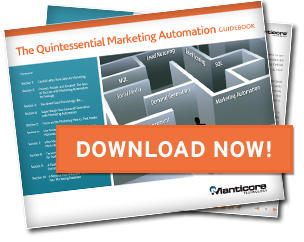
In Manticore’s Quintessential Marketing Automation GuideBook I’ve written a chapter on how to find untapped revenue in your marketing database. It consists of 6 steps that are guaranteed to uncover new opportunities:
Choose The Right AudienceMy chapter is only 1 of the 10 chapters in this book. Several of the leading marketing practitioners and consultants have written chapters on topics ranging from sales & marketing collaboration to conversion optimization and content marketing:
So a great guidebook, chock-full with valuable advice on marketing automation and lead management. Download it here.
On Thursday I’m presenting a webinar with Treehouse Interactive, called “Lead Nurturing 101″. One of the registrants sent me the following question:
How much of this webinar will be about content, i.e. exactly what to say in each subsequent email in a series designed to move someone from prospect stage to buying stage?
The webinar will only cover this briefly, so therefore I’m giving some more details this blog post. By the way, you can still register for the webinar.
Lead Nurturing content contains information that prospects need to make a purchase decision. It can come in various formats: (blog) articles, whitepapers, webinars, videos, podcasts, and so on. The content can be on the vendor’s website, it can be sent out via email, or sent out by sales people. In this post I’ll focus on content that is sent out via automated email campaigns (drip campaigns).
Different people need different content at different times. You can develop buyer personas and describe the content they need in the various buying stages. This process is called ‘content mapping’. Steve woods wrote a great primer on content mapping. With content mapping you can make sure that you cover all questions and objections that typically come up during the buying process.
However, it can be hard to apply content mapping to email nurturing. On your website, prospects will select the content they find interesting themselves, but in an email you are making a choice for them. So how do know what content they need at what time?
One option would be to assume that all new leads are just starting their buying process and need 6 months to make a decision. But that’s not how it works in real life: different people have different needs and are on a different schedule. The solution is to learn more about your prospects before you decide what content to send to them.
So to send the right content by email, you need to monitor prospects’ behavior. Web visits, document downloads, form submissions and email clicks will all give you an indication of the stage prospects are in. Based on their actions, you can enter prospects in the most appropriate nurturing campaign.
For example, if prospects download a whitepaper on the trends in your industry, they may also be interested in analyst reports or customer case studies. Or if they register for a demo of your product, a logical next step my be a product trial or a free consultation.
Once prospects have been entered in a particular lead nurturing track, keep monitoring their responses. For example, if prospects who downloaded a whitepaper earlier are now registering for a demo, you may want to switch campaigns. When the drip campaign has come to an end before the prospects are ready to buy, enter them in a long-term nurturing campaign.
Now we’re getting to the heart of the matter. If you know the email campaign, how do you decide which content should be in it, and in which order? I can share some approaches that work well for me in my consulting practice.
To determine the pieces of content, make a list of all the questions people typically ask in this stage. If you don’t know, ask your sales people, or simply call a couple of prospects and ask them. Also try to find out typical objections. Ideally, you provide content that addresses all questions and objections that prospects have in this stage of the buying process.
In your email campaign, start with a couple of educational emails that contain helpful content. The tone-of-voice of these emails should also be helpful (as opposed to being sales-oriented). Then start mixing in some more promotional content, which could be offers or product-related content. Once the campaign is running, carefully monitor open rates and click rates so you can optimize your messages. You’ll have to iterate a couple of times: it’s hard to create the ‘perfect’ campaign from the start.
There are only so many campaigns that you can realistically create. How can you keep it all manageable? My first recommendation is to focus on the most promising customer segments first. It’s better to do a great job nurturing the most important 20% of your prospects than do a bad job nurturing your entire database.
Second, keep the campaigns relatively simple. A simple but consistently executed campaign will give better results than a complex campaign that is hard to manage. It’s often best to start with linear campaigns: just sending one message after another, rather than branching based on the prospect’s behavior.
Let me know your tips for creating email nurturing content!
Learn how to nurture your leads and bring more revenue to your company. This webinar shows what you can do today to begin or enhance your lead nurturing programs. Thursday at 1pm PDT.
San Francisco: October 4-5 / Boston: October 25-26
Just like last year, I will be a blogging partner for MarketingSherpa’s B2B Marketing Summit. Again, they have created a great program for B2B Marketers, covering both lead generation and lead nurturing strategies.
What is nice about this summit is that most speakers are marketing practitioners, not vendors. Also, MarketingSherpa team members like Brian Carroll and Sergio Balegno are known for their excellent presentations.
Just some highlights:
MarketingSherpa has been very kind to create a special offer for LeadSloth readers. Normally the event is $1,695, regular discount is $200, but you get an extra $500 off. That makes $995. I think that’s a very good deal.
Visit this registration page to get the discount »
Tip: if you’re coming to the San Francisco summit and you like affordable and delicious Thai food, check out Siam Thai: it’s inside the Parc 55 hotel where the conference takes place.
While doing research for my webinar on creating content that converts, I found many great articles on B2B Content Marketing. Here are the 25 articles that I liked best. Most are blog posts, but I’ve also included some eBooks.
My focus is on B2B, rather than B2C. Often, some of the basics are the same, but not always. For example, the complex sale is usually unique to B2B selling, and that’s when you would map content to stages in the buying cycle. So here are the articles:
Joe Pulizzi, What is Content Marketing?
Michele Linn, A 7-Step Plan for Getting Started with Content Marketing
Doug Kessler, The B2B Content Marketing Workbook
Ardath Albee, 23 Reasons Why Content Marketing Fails
Adam Needles, What’s Behind the Rise of Content Marketing
Russell Sparkman, Creating Consistent Content – A Content Marketing Plan
Adam Needles, Why ‘Personas’ Are the Key to Achieving a ‘Mass One-to-one’ Strategy
Stephenie Tilton, Do You Have Any Idea Who You’re Talking To?
Adele Revella, How Kristine Developed a Great Buyer Persona
Tony Zambito, 10 Rules for Buyer Persona Development
Michele Linn, Is Less Content Better? 5 Steps to Simplify B2B Marketing Content
Stephenie Tilton, How Much B2B Content Is Enough?
Michele Linn, Need Content? 20 Formats to Consider
Ardath Albee, Content Marketing is for Customers Too!
Rick Burnes,5 Common Content Marketing Challenges — And Simple Solutions
Ardath Albee, Forgettable Follow-up on B2B Content Offers
Ardath Albee, The Rule of 5 for B2B Content Development
Michele Linn, The Dos and Don’ts of B2B Content Reuse
Michele Linn, Got Content? 10 Steps to Repurpose Your Best B2B Assets
Joe Pulizzi, BtoB Content Marketing: Six Places to Find Hidden Content Gems
Barbra Gago, Content Mapping 101 – part 1, part 2, part 3
Steve Woods, The Buying Process; Auditing your Content Assets
Steve Woods, The Content Gap – Lead Nurturing and Content Creation
Steve Woods, Buyer Roles, Buying Stages, and Perception Challenges
Jeffrey Ogden, Mapping marketing content across the buying cycle and personas
Please let me know if I forgot any seminal articles!
With the right content strategy, leads will move through the buying process more quickly and you’ll boost your conversion rates. To learn how, view this 30-minute on-demand webinar.
Live Webinar: Tuesday July 27th, 2010, 11am PDT/ 2pm EDT (recording available)
Segmentation of your database and development of personas allow you to develop the right messages, content and offers. This will dramatically increase the effectiveness of your lead nurturing campaigns. This 30-minute webinar presents a step-by-step approach to segmenting your database and developing personas for your most important target groups.
The following questions will be addressed:
In 30 minutes you will get practical tips that can result in conversion improvements ranging from 20% to 400%. I hope you can make it!
This is the recording of the webinar about the 7 Steps to Finding Untapped Revenue in Your Marketing Database, which took place on June 22nd, 2010. Please click the ‘play’ button to start. The total length is 28 minutes.
To see the slides, please visit SlideShare.
1. Introduction by Jep Castelein
2. 1848 James Marshall Discovers Gold
3. How Much REVENUE Are You Missing Out On?
4. NURTURE Leads to Assure More Revenue
5. 50% of Leads are NOTReady to Make the Jump
6. 23% BUY from a Competitor 6 Months after Initial Inquiry
7. Nurtured Leads Produce 20% MORE Sales Opportunities
8. # 1: COLLABORATE with Sales
9. # 2:CHOOSE the Right Audience
10. # 3: Know them WELL
11. # 4: Provide VALUE
12. # 5: Make OFFERS They Can’t Refuse
13. # 6: HAVE Conversations
14. # 7: Track & MEASURE
15. Case Study
16. The Complete Process
17. Need Help Finding those Gold Nuggets in Your Database? Let’s Talk!
18. Q&A
I’ve recorded an introductory video on lead nurturing and how it can turn more raw leads into qualified leads. Effective lead nurturing will prevent prospects from falling out of the funnel before they are ready to talk to a sales person.
This video is a preview of Tuesday’s webinar “7 Steps to Finding Untapped Revenue in Your Marketing Database“, which covers a comprehensive 7 step process to design a lead nurturing strategy.
The webinar is now available for watching on demand.
This Tuesday (June 22nd at 11am PDT) I’m presenting a webinar on the 7 steps to finding untapped revenue in your marketing database. Do you have many leads in your database who have never been followed up on? If yes, you have a lot of untapped revenue in your database. View this webinar to learn how to generate additional revenue from your existing leads.
This video gives an overview of the content of the webinar:
The webinar is now available for watching on-demand.